Science
Ocean temperatures on Earth hit record highs in 2025, and there is no stop in sight.
The majority of the planet's excess heat ends up in the ocean, but air temperatures make headlines. There, it can persist for decades, subtly influencing marine ecosystems, weather extremes, and sea levels. The amount of energy absorbed by the ocean is revealed by a recent worldwide investigation.
By Francis Damiabout 9 hours ago in Earth
🌍 World Enters Relax Mode After Rising War Tensions
🌍 World Enters Relax Mode After Rising War Tensions After months of rising tensions, military alerts, and global uncertainty, the world is finally entering what many experts are calling a “Relax Mode” from war fears. Diplomatic talks, ceasefire agreements, and renewed cooperation among nations are helping reduce anxiety and bring hope back to millions of people around the globe.
By Wings of Time about 14 hours ago in Earth
Two of the Biggest and the Best
It always amazes me how we have gotten to the point where there are so many special days. This story is two-fold. One is for Mikeydred’s unofficial April challenge. The second is to honour World Aquatic Animal Day, which is on April 3.
By Calvin Londona day ago in Earth
The Imposible Landing
On July 19, 1989, United Airlines Flight 232 departed Denver for Chicago, carrying 296 people across a clear Iowa sky. The DC-10 was a massive three-engine aircraft, a workhorse of the era, manned by a highly experienced crew. One hour into the flight, a violent jolt rocked the cabin as the rear engine, mounted on the tail fin, suffered a catastrophic failure.
By Edge Wordsa day ago in Earth
The Lake
The Terrifying Natural Phenomenon at Lake Natron THE DEATH TRAP OF TANZANIA 💀 In the remote northern reaches of Tanzania, near the border with Kenya at the base of a volcano called Ol Doinyo Lengai, there exists a lake so alkaline and so saturated with minerals that animals who die in its waters are preserved in a state of calcified perfection that makes them appear to have been turned to stone, their bodies encrusted with sodium carbonate and sodium bicarbonate deposits that harden into a shell so complete and so detailed that the preserved animals look like sculptures rather than corpses, frozen in whatever position they occupied at the moment of death with their feathers and fur and facial expressions captured in mineral rather than flesh, and photographs of these calcified animals which went viral when photographer Nick Brandt published his series "Across the Ravaged Land" in 2013 produced reactions ranging from disbelief to horror because the images looked like something from mythology rather than from nature, creatures literally turned to stone by a body of water that functions as one of Earth's most bizarre and most beautiful natural death traps 🌋
By The Curious Writer4 days ago in Earth
The Empty Quarter: The terrifying beauty and silence of the Rub' al Khali desert.
The low, rhythmic booming started in my molars before it ever reached my ears—a deep, sepulchral thrum that felt like the earth was trying to clear a throat made of pulverized glass. It wasn't a wind. It wasn't a storm. It was the dunes themselves. They were singing. The sound was a visceral, hollow groan, a vibration so intense it made the water in my canteen ripple in perfect, concentric circles. I stood on the spine of a crescent dune that rose six hundred feet into a sky the color of a fresh bruise. The heat didn't just touch the skin; it occupied it. It was a thick, airless weight that tasted of salt and ancient, sun-bleached silence. Everything was red. A staggering, deranged expanse of oxidized quartz that stretched until the curvature of the planet simply gave up.
By The Chaos Cabinet6 days ago in Earth
Researchers discover why certain volcanoes suddenly explode.
Researchers have discovered a shallower band of hot fluids over a deep pocket of melt beneath an active volcano. According to the new image, a calm surface may be deceiving because pressure can build up gradually before fractured rock gives way.
By Francis Dami8 days ago in Earth
The Squirrel Mirror:
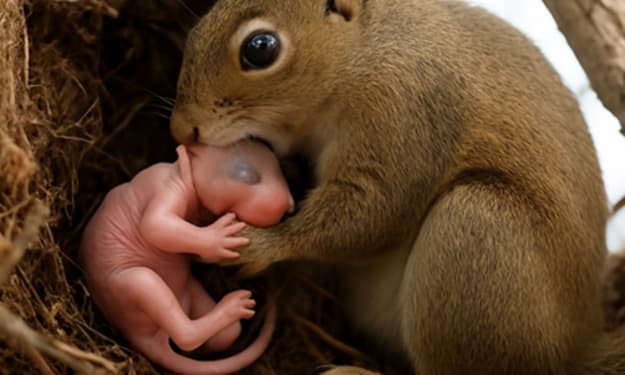
Humans love the idea of animals behaving nobly. The image of a squirrel cradling a tiny pink newborn seems to confirm our deepest hope—that love and care transcend instinct, species, and bloodlines. Social media amplifies this comforting myth with the same captioned claim: “Squirrels will adopt another squirrel baby if its parents die or can’t care for them.” It’s sweet, shareable, and slightly anthropomorphic.
By Dr. Mozelle Martin9 days ago in Earth