activism
Grassroots campaigns have proven instrumental in bringing about political, social or environmental change; you've got to start somewhere-might as well start here.
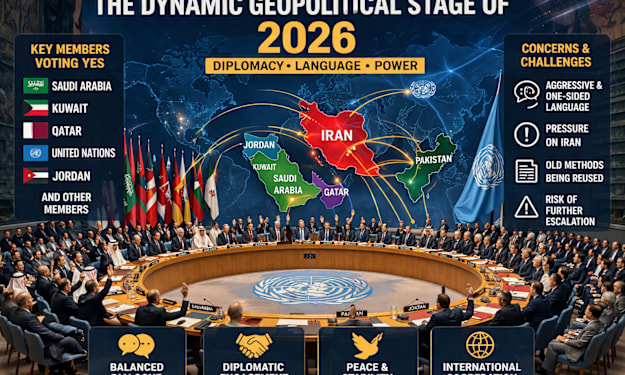
The Dynamic Geopolitical Stage of 2026: Diplomacy, Language, and Power
The year 2026 marks a deeply dynamic and sensitive phase in global geopolitics, where conflicts are no longer shaped solely by military actions or economic sanctions, but increasingly by diplomacy, narratives, and the strategic use of language. At the center of this evolving landscape stands the United Nations, which continues to function as the primary global platform for debate, negotiation, and the passing of resolutions. However, the role of the UN in 2026 is not without controversy, as questions arise about the fairness, tone, and implications of the decisions being made within its chambers.
By Ibrahim Shah about 10 hours ago in The Swamp
HEMP VS. ALCOHOL. Content Warning.
My ancestors on my dad’s side grew hemp for clothes, the first American flag, shoelaces, etc. Hemp was stronger and more durable for clothes, etc. My ancestor’s hemp farms were burned to the ground by the alcohol and cotton industries because they wanted to destroy their competition. My ancestors lived long ago. Here we are in America and other countries that would give us alcohol as a medicine to kill pain. Alcohol is a death toxin to body organs. I cannot drink alcohol, cannot metabolize it. I cannot take Tylenol or Ibuprofen because all three would kill me. I have stage 2 kidney disease, 5 spinal fractures, Thalassemia, a Mediterranean anemia, and fatty liver. I use hemp for my pain. If someone asks me not to use it for pain. I offer them my 5 spinal fractures in trade with them. Funny they walked off.
By Vicki Lawana Trusselli a day ago in The Swamp
Why Do Americans Use Socialism As An Insult?
Introduction I see this almost every day and it really does annoy me. people like Bernie Sanders and Robert Reich do it and it happened again today. Maybe it is my fault for following people on Social Media.
By Mike Singleton 💜 Mikeydred 2 days ago in The Swamp
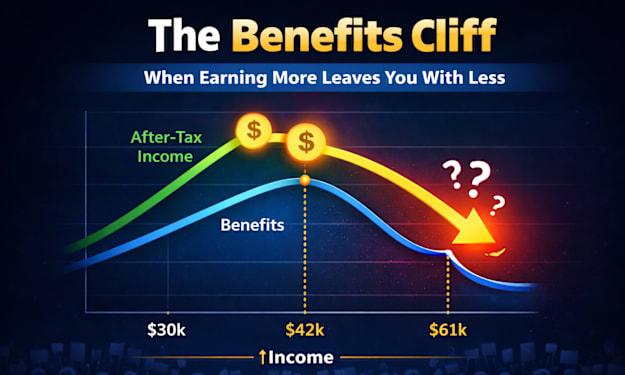
The "Benefits Cliff"
The System Is Not Cash, It Is Replacement For a family of five in Salem, Oregon, the low-income support system is not built primarily on direct cash transfers. It is built on a small number of high-impact programs that function as after-tax purchasing power, replacing major expenses rather than adding to pre-tax income. This distinction matters because it changes how the system must be evaluated. Income is taxed before it becomes usable, while benefits replace costs that would otherwise require after-tax dollars. That means these programs effectively operate as a parallel income structure, but one that is locked into specific categories such as food, housing, childcare, and healthcare rather than flexible cash.
By Peter Thwing - Host of the FST Podcast4 days ago in The Swamp
The Ecosystem
Why Swamps Are the Planet's Most Important and Most Misunderstood Landscape THE WORLD'S MOST HATED ECOSYSTEM 🐊 For centuries human civilization has treated swamps, marshes, bogs, and wetlands as wastelands, as obstacles to progress that should be drained, filled, developed, and converted into productive land, and this attitude has resulted in the destruction of approximately sixty-four percent of the world's wetlands since 1900 with the rate of loss accelerating in recent decades despite growing scientific understanding that wetlands are not wastelands but rather among the most ecologically valuable and productive ecosystems on Earth, providing services worth an estimated forty-seven trillion dollars annually including water purification, flood protection, carbon sequestration, biodiversity support, and coastal storm buffering that no human technology can replicate at comparable scale or cost, and the continuing destruction of these ecosystems represents one of the most catastrophic environmental miscalculations in human history driven by the fundamental misunderstanding that an ecosystem's value is determined by its utility for agriculture or development rather than by its ecological function 🌍
By The Curious Writer5 days ago in The Swamp
Four Countries Four Different roles in peace talk of US -Iran War
In the current global landscape, the Middle East has once again emerged as the center of international politics and economic concern. Rising tensions in the region have alarmed major world powers, highlighting the importance of certain countries that possess not only geographical significance but also strategic and diplomatic leverage. Among these, Pakistan, Turkey, Egypt, and Saudi Arabia stand out as key players capable of influencing the course of events.
By Ibrahim Shah 6 days ago in The Swamp
Is Britain Becoming Intolerant of Dogs?
Every time a dog attacks a person in the UK, it gets major coverage. Yes, the attack by a dog, if it results in death or injury, is horrible. And it is understandable why people want tighter laws on dogs. The government has clamped down on so-called aggressive dogs like XL bulldogs. However, is it actually the dog's fault?
By Nicholas Bishop7 days ago in The Swamp
Saudi Arabia East- West Petroline
The Middle East has long been the center of global energy politics, with its vast oil and gas reserves shaping not only regional dynamics but also the priorities of major world powers. However, in recent years, a critical question has emerged: should the world continue relying on a few strategic maritime chokepoints for energy transportation, or is it time to develop alternative routes?
By Ibrahim Shah 11 days ago in The Swamp
War, Diplomacy, and Power Politics:
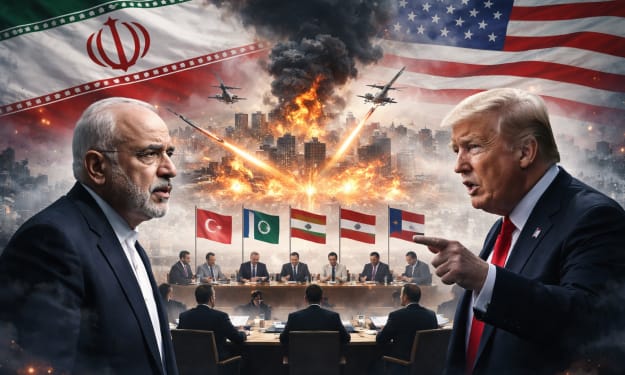
The ongoing tensions between Iran and the United States have entered a complex and multidimensional phase, where military escalation and diplomatic maneuvering are unfolding simultaneously. While the battlefield remains active, a parallel track of negotiations, mediation efforts, and summit proposals is gaining momentum, signaling that global powers are seeking to prevent a full-scale regional war.
By Ibrahim Shah 14 days ago in The Swamp
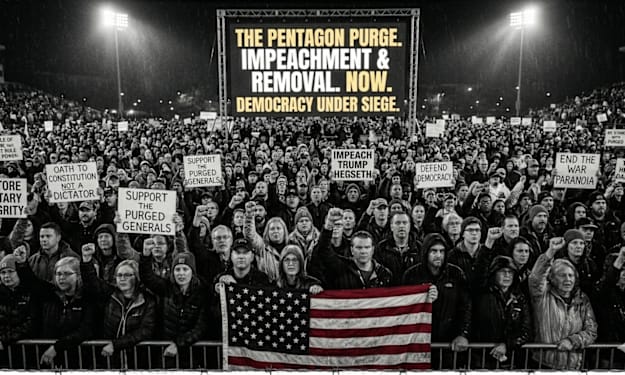
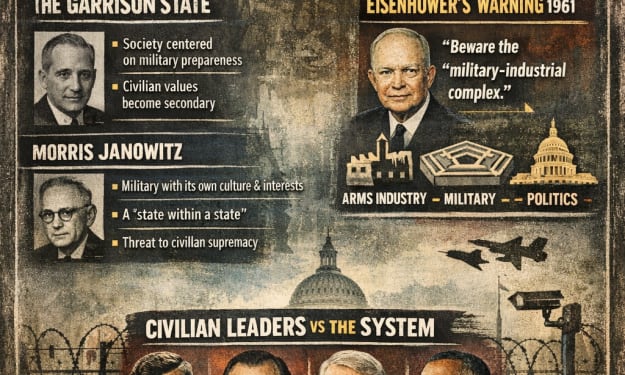
Militarization, Civilian Authority, and the Challenge to Democratic Governance
In modern political systems, one of the most subtle yet profound transformations occurs when societies gradually internalize a military mindset. This shift is not always visible, nor does it happen abruptly. Instead, it unfolds quietly, as civilians begin to perceive the world through the lens of security, threat, and strategic competition. Over time, the distinction between civilian and military leadership can erode, raising critical questions about the future of democratic governance.
By Ibrahim Shah 14 days ago in The Swamp