science
The Science Behind Relationships; Humans Media explores the basis of our attraction, contempt, why we do what we do and to whom we do it.
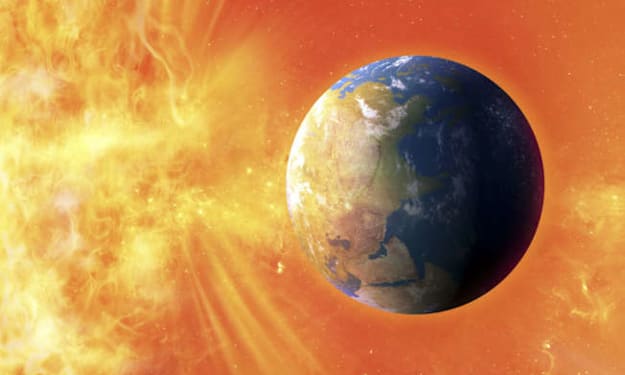
The Earth has already passed a point of no return
Earth's atmosphere is running out of time. Not tomorrow, not in a century, but in approximately one billion years, the air we breathe — the oxygen that every living creature on this planet depends upon — will become unbreathable. According to a landmark new study, there is nothing anyone can do to stop it.
By Shirley Oyiadomabout 4 hours ago in Humans
History’s Most Famous Biologist
Charles Robert Darwin transformed the way we understand the natural world with ideas that, in his day, were nothing short of revolutionary. Celebrated as one of the greatest British scientists who ever lived, but in his time, his radical theories brought him into conflict with members of the Church of England. All animals were created by God, except in Darwin’s eyes, they were not.
By Calvin Londonabout 9 hours ago in Humans
🌕 Humanity Returns to the Moon After 50 Years
A New Era of Space Exploration For the first time in more than 50 years, humanity is preparing to return to the Moon. The last time astronauts walked on the lunar surface was during Apollo 17 in 1972. Since then, the Moon remained quiet, visited only by robotic spacecraft and satellites. But today, a new space race has begun — and this time, the goal is not just to visit the Moon, but to stay.
By Wings of Time a day ago in Humans
When Population Panic Goes Viral
A chart shows up in a feed. The numbers are clean. The colors look official. Somebody adds one loaded word like “extinction,” and within minutes the comment section is full of panic, rage, and certainty. That sequence is common now.
By Dr. Mozelle Martin5 days ago in Humans
AI as a Reflective Surface
Much of the confusion surrounding artificial intelligence comes from treating it as an agent rather than a surface. When people speak about AI “doing the thinking,” “creating the ideas,” or “speaking for someone,” they are often projecting agency onto a system that does not possess intention, belief, or understanding. This projection obscures what is actually happening in many real-world uses. In those cases, AI is not acting as a source of meaning, but as a surface that reflects, redirects, and reshapes what is already present.
By Peter Thwing - Host of the FST Podcast5 days ago in Humans
Why Saying Less Makes Words Feel More Valuable
There is a widely held belief that words gain value through scarcity. When someone speaks rarely, their statements are treated as weightier, more deliberate, and more worth attending to. When someone speaks often, their words are assumed to be interchangeable, disposable, or less carefully considered. This intuition is not entirely wrong, but it is frequently misapplied. Scarcity does affect perception, but perception is not the same as truth, and rarity is not the same as meaning.
By Peter Thwing - Host of the FST Podcast5 days ago in Humans
The Science of Spirituality
Spirituality is not a destination to reach but is a frequency that is constantly being broadcast. Much like a radio station, it exists in space regardless of whether we have the ears or equipment to listen to it. It is entirely invisible to the eye and silent to the casual observer, yet its lack of physical presence does not diminish its reality or its power. Whether you are actively listening or lost in the static of daily life, the signal remains – unwavering and omnipresent simply waiting for to tune in. To unmask spirituality is to realize that the music has been here the whole time.
By Susan Eileen 7 days ago in Humans
THE PLAYLIST IN YOUR HEAD
The Neuroscience of Musical Memory and What It Reveals About Your Brain THE PLAYLIST IN YOUR HEAD You cannot remember what you had for lunch three days ago, you forget people's names within seconds of hearing them, you walk into rooms and cannot recall why you went there, and you struggle to retain information from books and lectures despite genuine effort to learn, but you can sing every word of a song you have not heard in twenty years, reproducing lyrics, melody, rhythm, and even the emotional quality of the original performance with accuracy that would be impossible for any other type of information stored for the same duration, and this dramatic disparity between your terrible general memory and your extraordinary musical memory reveals something profound about how your brain processes, stores, and retrieves information that has practical implications far beyond music for anyone who wants to learn more effectively, remember more reliably, and understand why certain experiences become permanently encoded while others vanish within hours.
By The Curious Writer7 days ago in Humans